
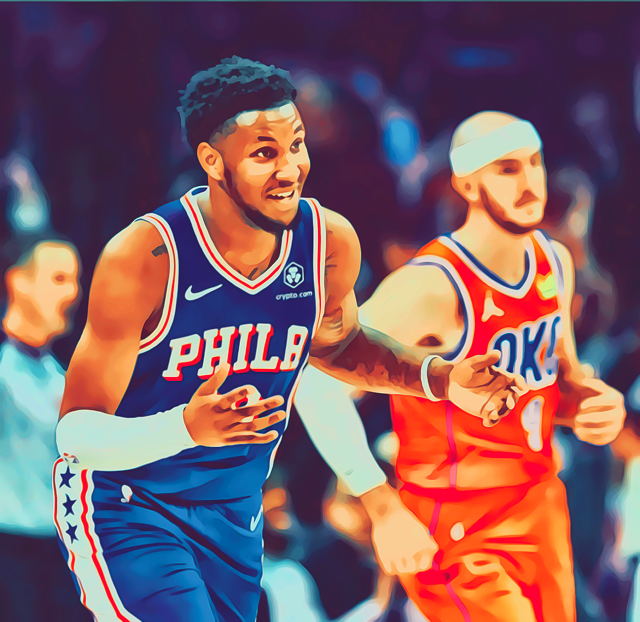
It is easy to forget how decorated of a prospect Justin Edward was amidst a rocky rookie campaign at Kentucky. The 6’7″ wing out of Philadelphia entered the 2023-2024 NCAA season ranked third among all college prospects according to Basketball Reference’s RSCI rankings.
But the struggle was real for any consistent playing time in John Calipari’s final year at Lexington, and Edwards quickly morphed away from the nation’s top small forward prospect (at the time ahead of lottery pick and UConn star Stephon Castle).
Signing his two-way contract with the Sixers should have been a path towards the G-League with a possible window into the NBA … one day. But injuries have forged Edwards into Philadelphia’s rotation since the start of the new year, and Edwards’ offensive contributions have not gone unnoticed.
With the team’s payroll heavily anchored on three stars, Edwards has gone from a fringe name within the organization to a possible key contributor under a manageable deal. And his play alongside Tyrese Maxey and Paul George is a significant reason for the tepid (and warranted) excitement.
Key Halfcourt Contributions
An essential measurable to any complementary player who wants to find success alongside Philadelphia’s star-studded trio is to impact the game on a low number of touches. Entering February, Edwards has checked this box off in fine detail, nearing among the top of the list of points per touch on a very limited basis (20 minutes per game on less than 15 front court touches).
| PLAYER | POINTS PER TOUCH | FRONT COURT TOUCHES |
| Zach Edey | 0.388 | 14.8 |
| Garrison Matthews | 0.366 | 14.5 |
| Brandon Clarke | 0.326 | 14.0 |
| Derrick Jones Jr | 0.324 | 14.8 |
| Sam Hauser | 0.320 | 12.7 |
| Sam Merrill | 0.312 | 14.0 |
| Justin Edwards | 0.306 | 13.9 |
Framing Edwards as a low usage widget provides a visual as to the role he is carving in the NBA, primarily as a bench centerpiece (on par to a similar role with the remaining players on this list).
But to get his foot firmly planted in Nick Nurse’s rotations, Edwards has to show the capacity to thrive off the ball, primarily with Maxey and George on the court. The early results have been quite impressive, with the ex-Kentucky name providing offensive balance on an increasing number of possessions (110 combined to date).
Take a look at some of the offensive output when Edwards, Maxey and George share the court (without Embiid):
- 147 points per half court possessions (100th percentile)
- 6.6 points added per 100 transition plays (99th percentile)
- 64.4% eFG (100th percentile)
It is wise to expect some regression to the mean from these otherwise gaudy offensive numbers. But with Edwards on the court, Philadelphia is clearly a step ahead of the opposition both in the halfcourt and in transition, even as an occasional afterthought on the box score.
For Edwards to stick in the long term, it will require the capacity to take (and hit) on a few open shots. So far thru January, he has been more than willing, attacking the opportunity with a high degree of confidence, with 28% of his three-point attempts deemed as open by NBA tracking data (second on the team behind Kyle Lowry).
Balancing the court from the perimeter is a massive chance for Edwards to crack the rotation, especially when you consider teammates Kelly Oubre and Caleb Martin both come under 17% in open three-point frequency. In other words, while the shots are there, both have a tendency to pass up looks that create a log jam in a single halfcourt set.
Leaning on Maxey’s Gravity
While the numbers stand out in a positive fashion for Edwards, it is his basketball feel and advanced understanding for a rookie that captures my intrigue. Playing off a player who demands extreme attention requires an understanding of where to be on the court and how to attack the space afforded. Edwards’ subtle movements in the perimeter provide the Sixers guard with passing angles that you generally do not get from a stationary player.
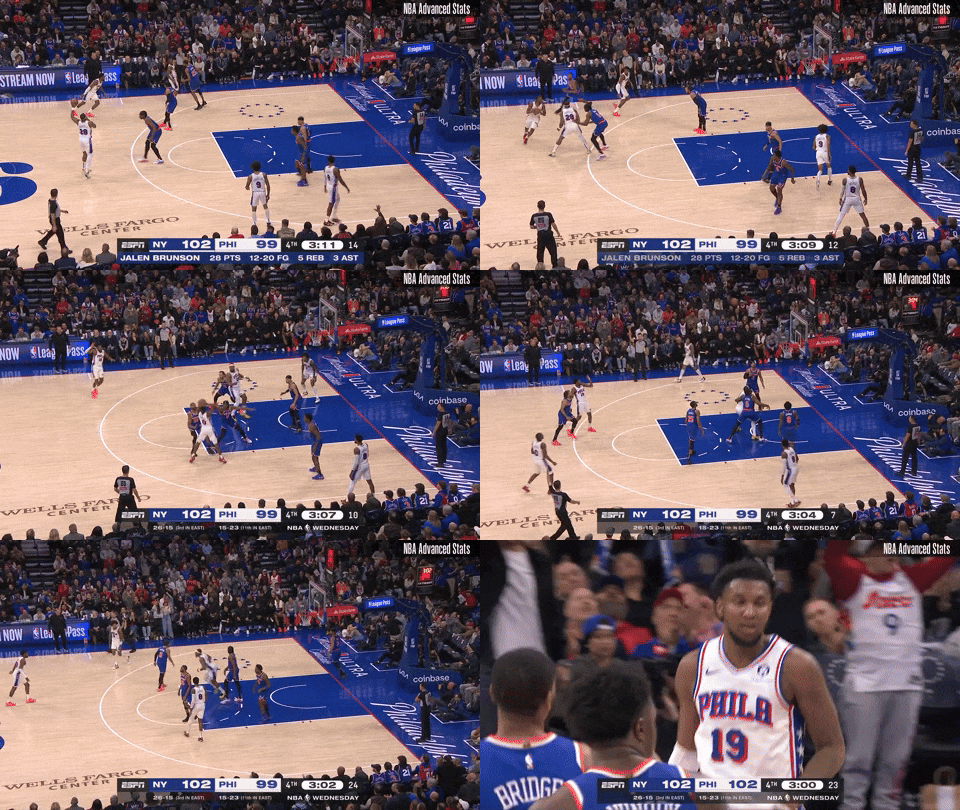
I have been impressed with Edwards’s quick trigger off the catch in the NBA. The speed at which he is able to get his shot off without much of a gather serves as a considerable advantage with defenders closing in on space.
With Maxey applying downhill pressure it is up to guys like Edwards to step into open shots and those seem to come in bunches with both on the court. I personally would love to see more of Edwards without Oubre on the court, allowing the Kentucky product to take more open looks like this one coming off a secondary Maxey assist.
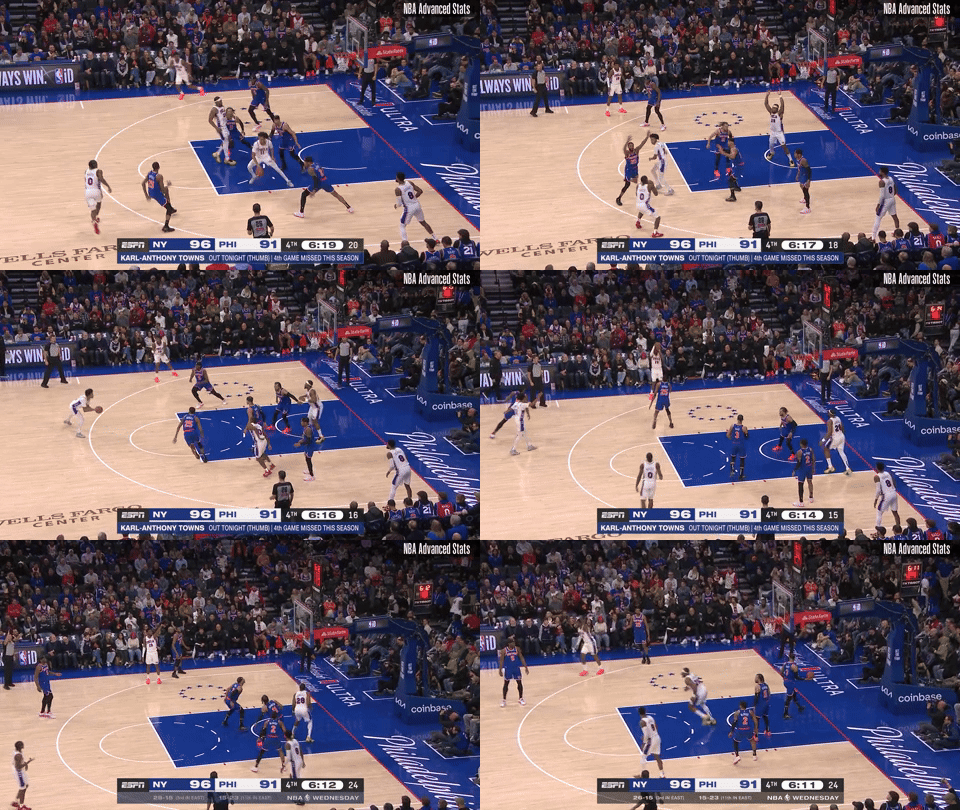
Edwards anticipation of the ball swing and the slide down into a shot-ready position is largely unnoticed on this clip, but it is one of the reasons why I am big on him as a shooter. It also shows a superior confidence level for a rookie, and a player who is attacking his minutes without much weight on his shoulders.
Whether that changes as expectations rise remains to be seen. But with the sample size available to us there are evident signs of a player that can possibly slot into a complimentary role with relative ease.
Deceptive Handle and Finishing
How often have you seen a Sixers wing player not capable of handing the basketball at a high enough level to attack a close-out? From Matisse Thybulle to PJ Tucker, Philadelphia has notoriously deployed perimeter players short of some of the basic tools necessary to succeed offensively.
Under Daryl Morey this has slowly changed, and Justin Edwards is another example of a lengthy wing who is not a black hole with the ball in his hands. While sample sizes remain low, there are subtle signs to suggest Edwards as a capable downhill finisher.
| FIELD GOALS MADE | eFG% | |
| 2 Dribbles | 5 | 78.6% |
| 3-6 Dribbles | 11 | 50.0% |
| 7+ Dribbles | 4 | 90.0% |
Contextualizing these metrics is an interesting thought experiment, primarily when you compare them to other wings on the team. For instance, at 3-6 dribbles, both Kelly Oubre and Caleb Martin register considerably lower in efficiency, with Martin posting a sub-40% eFG off those looks.
While no one expects Tyrese Maxey-level outputs off the bounce, Edwards has displayed a level of consistent skill, footwork, and touch that suggests a league-level finisher with the ball in his hands.
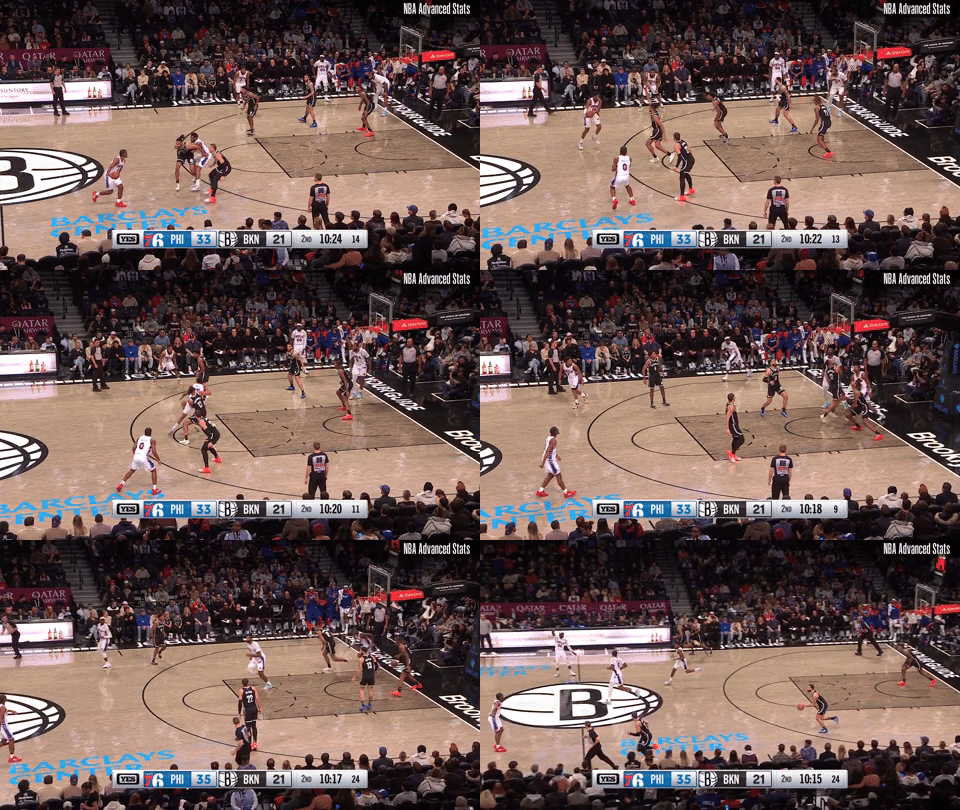
Edwards attacks to set-up his defender and has an advanced feel for changing directions, including a soft touch with the left hand that has generally been a reliable tool so far this season. The length and size combination at the rim also makes it incrementally difficult for defenders to contest the shot, even without eye-popping athleticisms on display.
Unearthing further development from Justin Edwards’ game should be a considerable target within the organization this year (and beyond). At face value, Edwards is already leaning towards a 3&D wing with connectivity traits. But defensively he is a consistent work in progress, while generating more events on that side of the ball a positive outcome to monitor. Most importantly, it is on the offensive end where I think Edwards has a future not only as a rotation piece, but as a viable starter in the next 1 to 2 seasons.
 Hoops & Harmony
Leave a comment